Week 2 is in the bag, and it was exciting to get hands-on with prompt engineering and coffee shops.
This week was my first encounter of new content as I began to learn more than what I had casually done before. I started again by asking ChatGPT to teach me through Week 2 of the course, where it covered the five core prompting techniques, describing each and giving clear examples for how to use them:
– Zero-Shot, just asking the model (my natural prompting)
– One-Shot, giving the model one example
– Few-Shot, giving the model multiple examples (more is always better)
– Role-Based, assigning the model a role/position to work from
– Chain-of-Thought, asking the model to think step-by-step
Then I went further than I did last week and actually did the practice that it gave me, which was helpful for the weekly assignment (who would’ve thought?). It started with the task of pitching a new coffee shop idea to potential investors, highlighting three prompting techniques (Zero-Shot, One-Shot, and Role-Based) and referring back to them as it wrote prompts, generated outputs, and asked me reflection questions on when each would best be used.
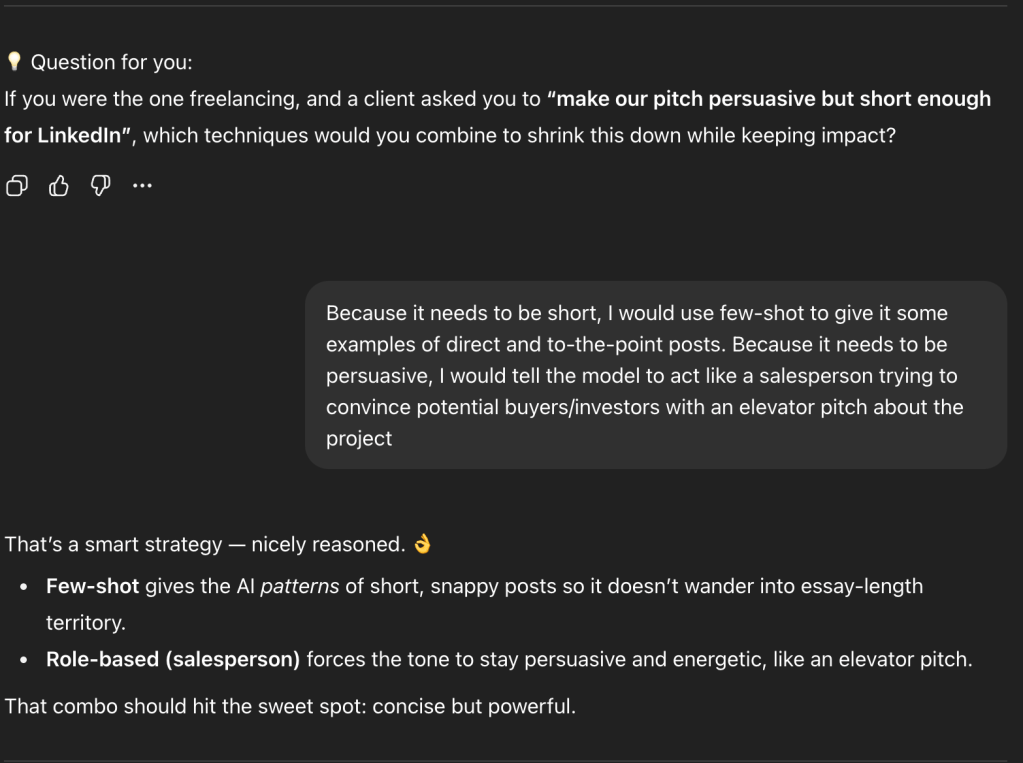
ChatGPT then went deeper into the lesson, showing me how combining multiple prompting techniques gets the best results and the different ways to use each technique. The lesson finished by exploring how I would go about creating a pitch and presenting it to a client, beginning to go beyond learning the skill and looking at how I can actually use it.
For the weekly project, I was assigned to use all five techniques for the same pitch task (at this point, I’m pretty much an expert on pitching a coffee shop), analyze what each prompt gave me, and reflect on how useful each response was in general and for freelancing.
I found that the best techniques for freelancing were One-Shot and Few-Shot. These each required more work on the front end of finding well-crafted pitches that related to my end objective (callback to last week), but the end result was much closer to what I had in mind than the other techniques. Plus, as I keep using them, I get a portfolio of examples to give the model, helping my future self. Role-Based also worked well, but would require more back-and-forth with the model to fine-tune because it had a lot more variables.
So, what have I learned so far? I’ve gone a step further from basic prompting to learn the different styles and explored the strengths of each, helping me see which is the most useful for freelancing. I got reminded again that more work on the front end will always save time afterwards and can give you a leg up when working with clients. All of this came together to remind me that, even if I’m attempting to streamline with AI, doing something well means understanding it thoroughly and being willing to experiment, especially when working with a client. Marketing plans, writing prompts, coffee shop pitches (my strong suit), it all becomes easier the more often you do it and the more work you put into it.
Next week looks beyond simply interacting with ChatGPT and dives into the other tools that prompt engineers use, exploring both their uses for freelancing and general life.
Final Score: 19/20, a point off because I could have gone deeper on a topic in my prompt analyses. I actually agree with the robot on this one.
If you want to see my full work, including the original prompts, raw results, and final essay, I’ve linked the Google Doc here.
 Boston Dato
Leave a comment